Grease Trap Pumping in Dothan, AL
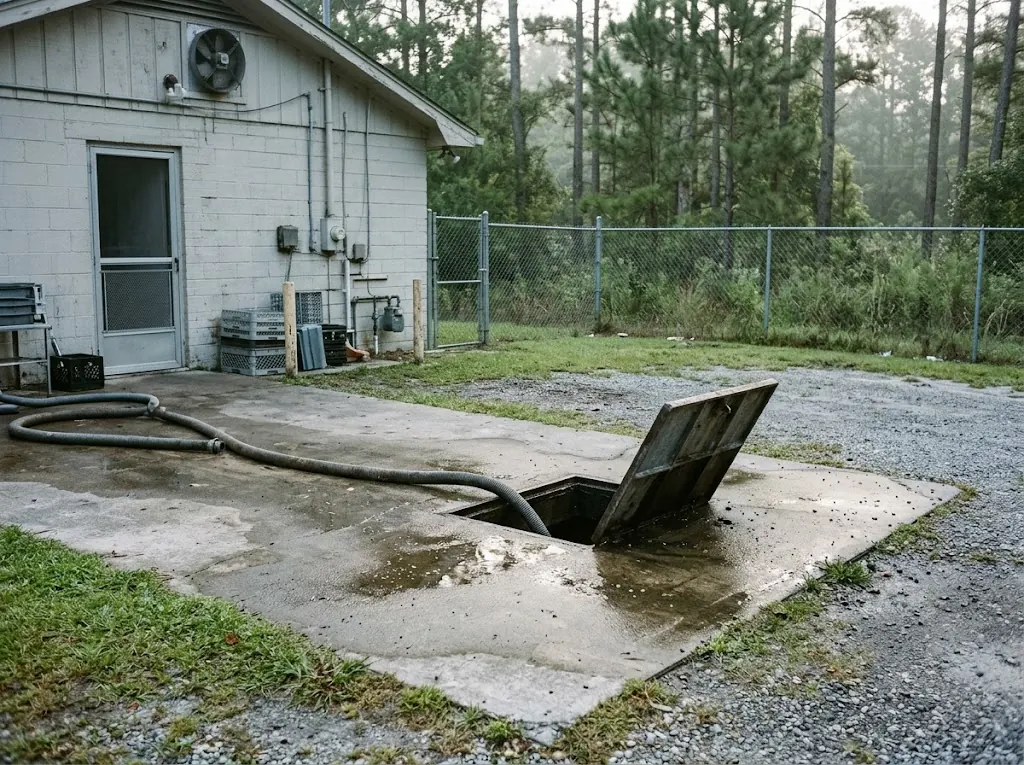
Call and we will connect you with an independent local provider.
CALL NOW: (334) 697-4929If you run a restaurant, cafeteria, food truck commissary or any other kitchen in Dothan, the fats, oils and grease (FOG) from cooking have to be caught before they reach the sewer. That is the job of your grease trap or grease interceptor, and it only works if it is pumped and maintained on schedule. Call (334) 697-4929 and we will try to connect you with an independent local grease waste hauler. Dothan Septic Pros is a referral service; we do not pump traps ourselves.
Grease traps vs grease interceptors
- Hydro-mechanical grease traps are smaller units, often under a sink or in the kitchen floor, ranging from roughly 20 to a few hundred gallons.
- Gravity grease interceptors (GGIs) are large in-ground tanks, often 1,000 gallons or more, usually outside behind the building.
Both separate grease and solids from wastewater. Grease floats, solids sink, and the cleaner water in the middle flows on. When the grease and solids take up too much of the space, grease passes through and can block the sewer line.
The City of Dothan FOG program
Food service establishments on Dothan's sewer system fall under the City of Dothan's Fats, Oils and Grease (FOG) program. Based on the city's published program information, key points include:
- Gravity grease interceptors must be cleaned at least every 90 days, or sooner if FOG and solids reach 25% of the capacity. The city has a form to request a waiver of the 90-day frequency.
- Hydro-mechanical grease traps must be cleaned at least every 30 days, or sooner if FOG and solids exceed 25% of capacity.
- Approved haulers. Interceptors must be pumped by a grease waste hauler on the city's approved list, and annual inspection and certification must be done by a city-certified hauler or plumber.
- Manifests. Grease waste hauled from a food service establishment must be documented on the city's non-hazardous waste manifest.
- Records. Maintenance and cleaning records must be kept on site for at least three years and shown to FOG inspectors on request.
The FOG program is run by Dothan Utilities, the same city utility that operates Dothan's sewer system of more than 500 miles of pipe and three treatment plants, so grease that slips past a trap on Ross Clark Circle or downtown ends up in the city's lines and pump stations. Program rules can change. Check with the City of Dothan FOG Program for current requirements, and confirm that any hauler you hire is on the city's approved list. Businesses outside Dothan's sewer service area should ask their own utility or the county health department what applies. County health departments can also be involved with grease traps at septic-served sites; Dale County, for example, lists septic tank, grease trap and holding tank permits among its environmental services.
What happens during a pump-out
- The hauler opens the trap or interceptor and measures the grease and solids layers.
- The contents are pumped out completely, including the grease cap and bottom solids.
- Walls, baffles and inlet and outlet tees are scraped and checked for damage.
- The hauler completes the manifest and gives you a service record for your files.
- Any problems, such as broken baffles or a cracked lid, are noted for repair.
What grease trap pumping costs
Prices below are typical national-guide ranges, not quotes.
| Trap type | Typical national-guide range per service |
|---|---|
| Small indoor trap, regular service | Roughly $130 to $200 |
| Small indoor trap, one-time pumping | Roughly $200 to $250 |
| 1,000 to 1,500-gallon interceptor, ongoing contract | Roughly $240 to $330 |
| Overall range, all sizes | Roughly $120 to $1,100 |
Larger interceptors, overdue service, hard-to-reach locations and emergency calls cost more. Regular contracts are usually cheaper per visit than one-time calls.
How long it takes
A small indoor trap can often be serviced in under an hour. A large outdoor interceptor may take one to two hours. Many restaurants schedule service before opening or after closing to avoid disrupting the kitchen.
Best practices for your kitchen
- Scrape plates and pans into the trash before washing.
- Never pour fryer oil or grease down a drain; use a used-cooking-oil container and recycler.
- Use sink strainers to catch food solids.
- Keep a cleaning log and file every manifest.
- Train new staff on what does and does not go down the drain.
Rural kitchens on septic
Some food businesses, churches, camps and event venues outside city sewer service use a septic system with a grease interceptor in front of it. Grease reaching a septic drain field can clog it quickly, so keeping the interceptor pumped protects an expensive system. In Alabama, septic and grease trap pumpers are licensed by the Alabama Onsite Wastewater Board, which lists grease traps among the tanks its pumper license covers.
Questions to ask a hauler
- Are you on the City of Dothan's approved grease waste hauler list?
- Are you certified to do the annual inspection and certification?
- Will you provide the city manifest and a service record each visit?
- Do you pump the full contents, not just skim the top?
- What is your price on a recurring schedule versus a one-time call?
- Do you hold an Alabama Onsite Wastewater Board pumper license?
Call (334) 697-4929 to get connected.
Call and we will connect you with an independent local provider.
CALL NOW: (334) 697-4929Frequently asked questions
How often must a grease interceptor be pumped in Dothan?
Under the City of Dothan FOG program, gravity grease interceptors must be cleaned at least every 90 days, or sooner if grease and solids reach 25% of capacity. Check with the city for current rules.
Can any pumping company clean my grease interceptor in Dothan?
The city requires an approved grease waste hauler for interceptor pumping. Ask the hauler to confirm they are on the city's list.
How much does grease trap pumping cost?
As a typical national-guide range, small traps often cost roughly $130 to $250 per service and 1,000 to 1,500-gallon interceptors roughly $240 to $330 on a contract.
How long do I keep grease trap records?
The City of Dothan FOG program requires food service establishments to keep maintenance and cleaning records on site for at least three years.
Areas we serve
We connect callers across Dothan, Enterprise, Ozark, Headland and the Wiregrass of southeast Alabama, including:
- Dothan
- Enterprise
- Ozark
- Headland
- Taylor
- Kinsey
- Cowarts
- Ashford
- Webb
- Rehobeth
- Newton
- Daleville
- Abbeville
- Slocomb
- Houston County
- Dale County
Local pages: Enterprise, Ozark, Headland.
Related services
- Septic Tank Pumping
- Septic Inspection
- Septic and Drain Field Repair
- Septic Installation and Replacement
- Emergency Septic Backup
Call and we will connect you with an independent local provider.
CALL NOW: (334) 697-4929