Septic System Inspection in Dothan, AL
Call and we will connect you with an independent local provider.
CALL NOW: (334) 697-4929A septic inspection tells you what condition your tank and drain field are in, how full the tank is, and whether anything needs repair. It is the smart first step if you are buying a home on septic in Dothan or the Wiregrass, selling one, or noticing slow drains and odors. Call (334) 697-4929 and we will connect you with an independent, licensed local septic provider. Dothan Septic Pros is a referral service; we do not inspect systems ourselves.
When you need an inspection
- Buying a home. A standard home inspection usually does not cover the septic system in any depth. A failed drain field can cost thousands of dollars, so many buyers order a separate septic inspection during the due diligence period. Ask your agent and lender whether one is required for your loan.
- Selling a home. A recent inspection and pumping record can reassure buyers and head off surprises late in the sale.
- Routine checkups. The EPA suggests having a household system inspected about every three years, and more often for systems with pumps, aerators or other mechanical parts.
- Warning signs. Slow drains, gurgling, odors, wet spots or backups all deserve a look.
- Before adding on. Adding a bedroom, a pool, a driveway or an outbuilding near the system? An inspection helps find where the tank and drain lines are and whether the system can handle more use.
What a septic inspection includes
There is no single national standard, and inspections range from a quick visual check to a full evaluation. Ask exactly what is included. A thorough inspection usually covers:
- Records review. The provider asks for any permit, pumping or repair records. The county health department may have the original permit and a sketch of the system for some properties.
- Locating the components. Finding the tank, the distribution box if there is one, and the drain field.
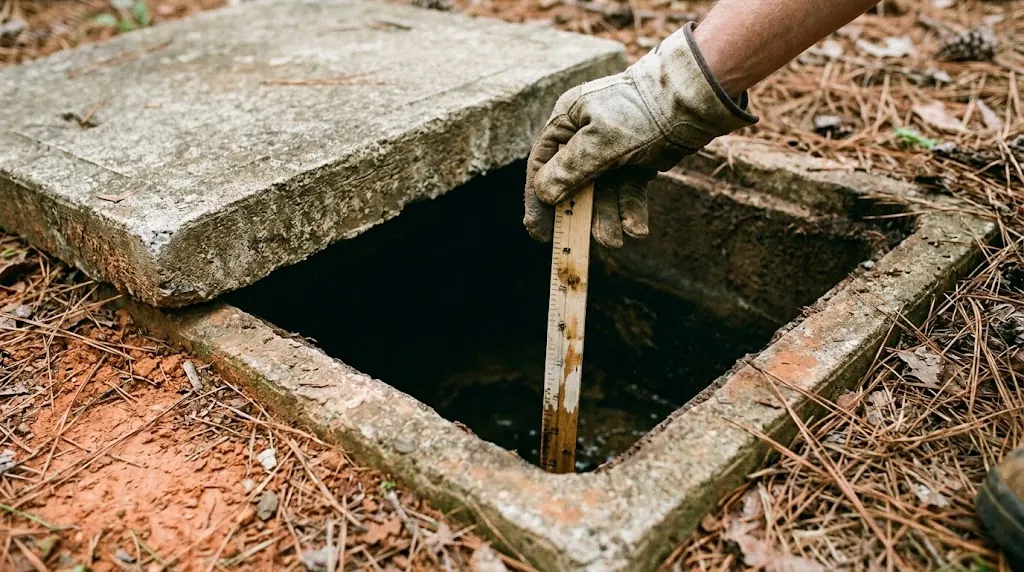
- Opening and measuring the tank. Measuring the sludge and scum layers to see how full it is.
- Checking the tank. Looking at baffles or tees, the inlet and outlet pipes, the lids and the tank walls for cracks or deterioration.
- Flow test. Running water in the house to check that it flows freely to the tank and on to the field without backing up.
- Drain field check. Walking the field for soggy ground, odors or surfacing effluent, and sometimes probing the soil.
- Mechanical parts. If the system has a pump, alarm, or aerobic treatment unit, checking that each works.
- Written report. A summary of what was found, with photos if you ask, and recommendations.
Some providers add a camera inspection of the sewer line or the drain lines. It is not always necessary, but it can help when there is a suspected break or root intrusion.
What an inspection costs
Prices below are typical national-guide ranges, not quotes.
| Type of inspection | Typical national-guide range |
|---|---|
| Basic visual inspection | Often a few hundred dollars |
| Full inspection (opening tank, measuring, flow test, field check) | Roughly $250 to $1,200 |
| Camera inspection added | Can roughly double the cost |
| Pumping done at the same visit | Typically priced separately, roughly $300 to $600 |
Many providers recommend pumping at the time of inspection, because an empty tank is much easier to examine. Ask whether a combined price is available.
How long it takes
A full inspection of a typical home system takes about one to three hours on site, longer if the tank must be found and dug up. A written report may follow the same day or within a few days. For a home purchase, book early so the report arrives well inside your inspection window.
Reading the results
An inspection usually ends with one of three answers. Everything is working and the tank just needs routine pumping. A repair is needed, such as a broken baffle, a cracked lid or a failed pump. Or the drain field is showing signs of failure and needs more evaluation. If a repair or replacement is recommended, ask for a written estimate, and remember that in Alabama repairs to an onsite system generally require a permit from the county health department. Getting a second opinion on a large repair is reasonable.
Inspecting a septic system in the Wiregrass
Start with the county records. In Alabama the county health department issues septic permits, so it is the first place to ask for a permit file or a sketch of the system. For most Dothan-area homes that is the Houston County Health Department environmental office (334-678-2815) on East Cottonwood Road, one block east of Ross Clark Circle. A house in Rehobeth, Taylor or out toward Wicksburg is still Houston County; a home just over the line toward Ozark, Headland, Hartford or Enterprise falls under Dale, Henry, Geneva or Coffee County. Older farmhouses often have no file at all, so plan on the inspector locating the system.
Know the soil. The Dothan soil series takes its name from here and was first established in Houston County in 1965. USDA describes it as very deep and well drained, but with plinthite starting roughly 24 to 60 inches down, where water moves more slowly. Fuquay soils, also found in the area, have 20 to 40 inches of sand on top and a seasonal high water table that USDA puts at about 40 to 60 inches or deeper, mainly January to March. Low ground near creeks and branches can stay wet much longer. So the season matters: a field that looks fine in a dry October can show trouble in a wet August or late winter. Ask the inspector how recent rainfall affects what they found.
Buyers on a timeline. Many Dothan-area buyers are relocating for jobs at Fort Rucker and elsewhere and are buying from a distance. Book the septic inspection early in your due diligence period, ask for photos, and ask for pumping at the same visit so the tank can be properly examined.
Licensing and permits in Alabama
In Alabama, septic work is regulated at two levels. The Alabama Onsite Wastewater Board (AOWB) licenses the people who do the work: pumpers, installers (at basic and advanced levels) and tank manufacturers. Anyone working as a septic pumper or installer is required to hold an AOWB license, or for a company, the person in responsible charge must. The board has an online roster search, so ask for the license number and look it up yourself. The Alabama Department of Public Health (ADPH), through each county health department, issues the permits. Under Alabama rules, a permit from the local health department is required before a new onsite system is installed or an existing one is repaired. Routine pumping does not usually need a permit, but repairs and replacements do. Rules can change, so confirm the current requirements with the provider and your county health department.
Questions to ask before you book
- What exactly does your inspection include, and will I get a written report?
- Will you open and measure the tank, or only look at the surface?
- Do you recommend pumping at the same visit, and what does that cost?
- Do you check pumps, alarms or aerobic units if the system has them?
- What is your AOWB license number?
Call (334) 697-4929 to get connected.
Call and we will connect you with an independent local provider.
CALL NOW: (334) 697-4929Frequently asked questions
Does Alabama require a septic inspection when a house is sold?
Requirements can depend on the lender, the loan type and the sale contract. Ask your real estate agent and lender. Many buyers order one either way.
How much does a septic inspection cost?
As a typical national-guide range, a full inspection runs roughly $250 to $1,200. A camera inspection costs more. Ask what is included.
Should the tank be pumped during the inspection?
Often, yes. An empty tank is easier to inspect for cracks and baffle problems. Pumping is usually priced separately.
Where can I find my septic system records?
Start with the seller or previous owner, then ask the county health department, which issues septic permits in Alabama.
Areas we serve
We connect callers across Dothan, Enterprise, Ozark, Headland and the Wiregrass of southeast Alabama, including:
- Dothan
- Enterprise
- Ozark
- Headland
- Taylor
- Kinsey
- Cowarts
- Ashford
- Webb
- Rehobeth
- Newton
- Daleville
- Abbeville
- Slocomb
- Houston County
- Dale County
Local pages: Enterprise, Ozark, Headland.
Related services
- Septic Tank Pumping
- Septic and Drain Field Repair
- Septic Installation and Replacement
- Emergency Septic Backup
- Grease Trap Pumping
Call and we will connect you with an independent local provider.
CALL NOW: (334) 697-4929