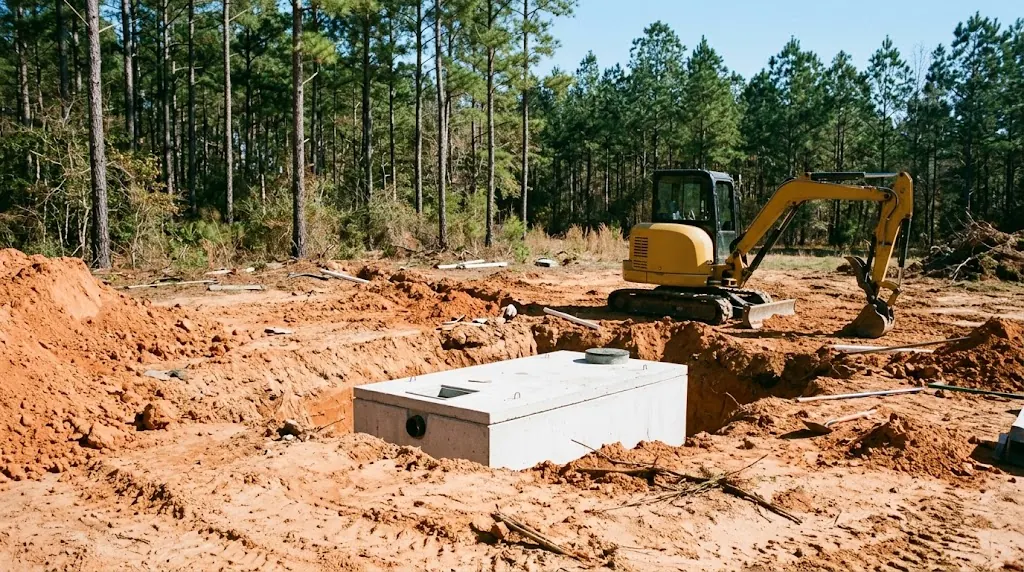
Septic System Installation and Replacement in Dothan, AL
Call and we will connect you with an independent local provider.
CALL NOW: (334) 697-4929Whether you are building a new home on a rural lot outside Dothan or replacing a system that has finally failed, a septic installation is a regulated project with several steps before anyone starts digging. Call (334) 697-4929 and we will connect you with an independent, licensed local septic installer. Dothan Septic Pros is a referral service; the installer quotes and does the work.
When you need a new system
- New construction on land without public sewer, which describes many lots across rural Houston, Dale, Henry and Geneva counties.
- A failed drain field that cannot be repaired.
- A collapsed or badly cracked tank, common with very old steel or deteriorated concrete tanks.
- Adding bedrooms or a second dwelling, when the existing system is too small for the new use.
The permit and soil testing come first
Under Alabama law, a permit from the local county health department, part of the Alabama Department of Public Health, is required before a new onsite system is installed. The Houston County Health Department describes the process this way:
- Soil testing. The owner or the owner's agent hires a qualified professional, such as a registered engineer, land surveyor, professional soils classifier or geologist, to evaluate the soil. A registered engineer is required for designed systems, for soils that do not absorb water well, for sites where seasonal saturation is too shallow for a conventional system, and for large systems.
- Application. The application goes to the health department with the fee, the soils information, a legal description of the property, a plot plan, a vicinity map and sometimes a construction plan.
- Review and permit. The health department reviews the application and, if it is approved, issues a permit to install.
- Installation and inspection. A licensed installer builds the system according to the permit, and the work is inspected.
Confirm the current steps and fees with your county health department, since procedures can vary by county and change over time. Your installer will usually know the local process well.
Types of systems
- Conventional gravity system. A septic tank and a gravel or chamber drain field fed by gravity. The simplest and usually least expensive option where soil allows.
- Chamber systems. Plastic chambers in place of gravel in the trenches. Common in many conventional installs.
- Pump systems. When the field is uphill from the house or needs pressure dosing, a pump tank and alarm are added.
- Mound systems. Used when the natural soil is too shallow or too wet. Treated effluent is pumped to a raised bed of sand and soil.
- Aerobic treatment units (ATUs). Add air to treat wastewater more fully before it reaches the soil. They need electricity and regular servicing.
The soil evaluation largely decides which system your lot needs. Alabama licenses installers at basic and advanced levels; advanced licenses cover larger systems and pump-dosed and other advanced systems, so make sure the installer's license level matches the system on your permit.
What installation costs
Prices below are typical national-guide ranges, not quotes. Soil conditions, system type, lot access and permit requirements change the price a lot.
| Item | Typical national-guide range |
|---|---|
| Soil evaluation | Roughly $100 to $400 |
| System design (when required) | Roughly $450 to $900, more with engineering |
| Permit | Roughly $250 to $1,000, varies by state and county |
| Conventional system with drain field | Roughly $8,000 to $13,000 |
| Aerobic treatment unit system | Roughly $10,000 to $20,000 |
| Mound system | Roughly $12,000 to $20,000 |
| Tank replacement only (1,000-gallon concrete, installed) | Roughly $2,300 to $6,500 |
| Drain field only | Roughly $5,000 to $12,000 |
How long it takes
Soil testing, design and permit review can take anywhere from a couple of weeks to a couple of months, depending on the season and workload. Once the permit is issued, a conventional installation typically takes one to three days on site. Mound and aerobic systems take longer. Wet weather is the most common delay; installers avoid excavating saturated ground.
Building on septic in Houston County and the Wiregrass
Which office. Most new homes on septic around Dothan are permitted by the Houston County Health Department's environmental office (334-678-2815) on East Cottonwood Road, behind the Houston County Farm Center. Building near Ozark, Headland or Abbeville, Enterprise, or Hartford and Slocomb means the Dale, Henry, Coffee or Geneva county office instead. Our permit guide lists each one.
Splitting family land. Many Wiregrass homes go up on a parcel carved out of family farmland. Alabama's onsite rules require a new permit application to the local health department before a lot is divided into a smaller parcel, so talk to the health department before you survey off an acre for a house.
What the soil test will find. The Dothan soil series was first established in Houston County, and its type location is the Wiregrass Agricultural Experiment Station in Henry County. These soils are well drained up top, with plinthite starting roughly 24 to 60 inches down. Fuquay soils have 20 to 40 inches of loose sand over the subsoil. Orangeburg soils, also common on Coastal Plain uplands, are deep and well drained without plinthite. Where the slow layer or seasonal saturation is too shallow for a conventional trench, Houston County's process requires a registered engineer, and the result may be a pump-dosed or mound system installed by an Advanced Level installer.
Power and storms. Pump and aerobic systems need electricity. After Hurricane Michael in 2018, Houston County had about 10,000 Alabama Power customers out on the first morning, and outside utility crews were brought into Dothan to help restore power. If you are choosing between system types, ask the installer how each behaves during a multi-day outage.
Planning tips for Wiregrass lots
- Have the soil evaluated before you finalize the house location, driveway and any pool or shop. The best soil on the lot should be saved for the drain field and a possible future repair area.
- Keep heavy equipment, trucks and building materials off the planned drain field area during construction, since compaction ruins absorption.
- Low spots near creeks and branches, and areas where water stands after summer storms, are often poor drain field sites.
- Ask for an as-built drawing showing where the tank and lines are. You will need it for future pumping and repairs.
Licensing and permits in Alabama
In Alabama, septic work is regulated at two levels. The Alabama Onsite Wastewater Board (AOWB) licenses the people who do the work: pumpers, installers (at basic and advanced levels) and tank manufacturers. Anyone working as a septic pumper or installer is required to hold an AOWB license, or for a company, the person in responsible charge must. The board has an online roster search, so ask for the license number and look it up yourself. The Alabama Department of Public Health (ADPH), through each county health department, issues the permits. Under Alabama rules, a permit from the local health department is required before a new onsite system is installed or an existing one is repaired. Routine pumping does not usually need a permit, but repairs and replacements do. Rules can change, so confirm the current requirements with the provider and your county health department.
Questions to ask the installer
- What is your AOWB license number and installer level?
- Who arranges the soil evaluation and the permit application?
- What type of system does the soil call for, and why?
- What exactly does the quote include: tank, field, pump, electrical, backfill, seeding?
- What warranty is offered on parts and workmanship, in writing?
- Will I get an as-built drawing and the final inspection record?
Call (334) 697-4929 to get connected.
Call and we will connect you with an independent local provider.
CALL NOW: (334) 697-4929Frequently asked questions
Do I need a permit to install a septic system in Alabama?
Yes. Alabama law requires a permit from the local county health department before a new onsite system is installed or an existing one is repaired.
Who does the soil test for a septic permit?
In Houston County, the health department says soil testing is done by a registered engineer, land surveyor, professional soils classifier or geologist, with an engineer required for some sites.
How much does a new septic system cost?
As a typical national-guide range, a conventional system often runs roughly $8,000 to $13,000. Mound and aerobic systems often cost $10,000 to $20,000.
Can I install my own septic system?
Alabama requires septic installers to be licensed by the Alabama Onsite Wastewater Board. Ask your county health department about the rules before planning any do-it-yourself work.
Areas we serve
We connect callers across Dothan, Enterprise, Ozark, Headland and the Wiregrass of southeast Alabama, including:
- Dothan
- Enterprise
- Ozark
- Headland
- Taylor
- Kinsey
- Cowarts
- Ashford
- Webb
- Rehobeth
- Newton
- Daleville
- Abbeville
- Slocomb
- Houston County
- Dale County
Local pages: Enterprise, Ozark, Headland.
Related services
- Septic Tank Pumping
- Septic Inspection
- Septic and Drain Field Repair
- Emergency Septic Backup
- Grease Trap Pumping
Call and we will connect you with an independent local provider.
CALL NOW: (334) 697-4929