Septic Repair and Drain Field Repair in Dothan, AL
Call and we will connect you with an independent local provider.
CALL NOW: (334) 697-4929Most septic problems start small: a slow drain, a smell near the tank, a wet patch in the yard. Caught early, many can be fixed with a part or a short section of pipe. Left alone, they can turn into a failed drain field. Call (334) 697-4929 and we will connect you with an independent, licensed local septic provider who can find the cause and give you a written quote. Dothan Septic Pros is a referral service; we do not do repairs ourselves.
Common septic repairs
- Baffles or tees. The baffles at the tank's inlet and outlet keep scum and solids in the tank. Older concrete baffles crumble, and missing outlet baffles let solids flow into the drain field. Replacing a baffle is one of the most common and most important repairs.
- Effluent filter. Many newer tanks have a filter at the outlet. A clogged filter can back water up into the house; cleaning or replacing it is a simple fix.
- Lids and risers. Cracked or broken lids are a safety hazard, especially with children and pets. Risers bring access to the surface for easier pumping.
- Inlet and outlet pipes. Roots, settling and crushed pipe between the house and tank, or between the tank and field, cause backups.
- Pumps and alarms. Systems with a pump tank, a mound or an aerobic treatment unit depend on pumps, floats and alarms that wear out.
- Distribution box. A tilted or broken distribution box can send all the water down one line, overloading part of the field.
- Tank cracks. Cracks let groundwater in or sewage out. Some can be sealed; a badly damaged tank may need replacing.
Drain field problems
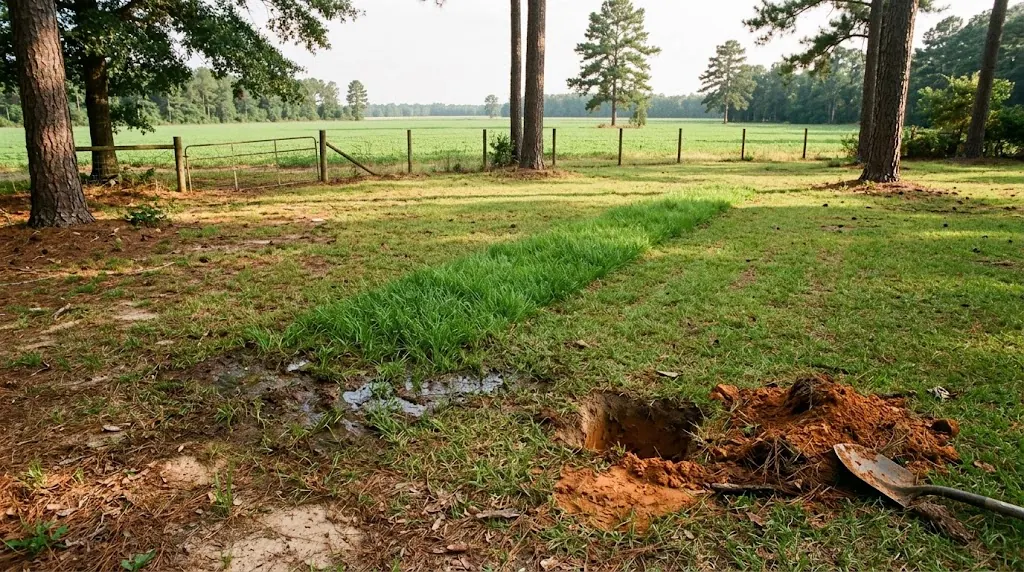
The drain field, also called the leach field or absorption field, is where most of the treatment happens. It fails when the soil can no longer absorb the water, usually because solids washed out of an overdue tank, roots got into the lines, the field was driven on and compacted, or too much water was sent to it. Signs include:
- Soggy ground, standing water or sewage odor over the field
- Bright green stripes of grass over the lines in dry weather
- Slow drains that do not improve after the tank is pumped
- Water flowing back into the tank from the field during pumping
Options range from cleaning or jetting the lines, to replacing a damaged line or the distribution box, to adding new trench, to a full drain field replacement. In some cases, resting the field by cutting water use and fixing leaks helps. A provider should explain why they recommend one option over another.
How a repair is done
- Diagnosis. The provider usually pumps the tank, checks baffles and pipes, and may run a camera down the lines or dig test holes in the field.
- Written estimate. Get the scope and price in writing before work starts.
- Permit. In Alabama, repairing an onsite system generally requires a permit from the county health department, and some repairs need soil testing by a qualified professional first. The provider should explain what is required and who handles it.
- The repair. Parts are replaced or new line installed. Larger field work uses an excavator and may need an inspection before backfill.
- Restoration. Trenches are backfilled and the yard is graded. Ask whether seeding or sod is included.
Typical repair costs
Prices below are typical national-guide ranges, not quotes. Your price depends on the cause, access, soil and permit requirements.
| Repair | Typical national-guide range |
|---|---|
| Service call or diagnostic visit | Roughly $100 to $300 |
| Baffle repair or replacement | Roughly $300 to $900 |
| Effluent filter replacement | Roughly $200 to $300 |
| Lid replacement | Roughly $150 to $500 |
| Septic pump repair | Roughly $250 to $400 |
| Septic pump replacement | Roughly $1,000 or more |
| Broken pipe repair | Often around $600 |
| Lateral line replacement | Roughly $1,500 to $5,000 |
| Drain field repair or replacement | Roughly $2,000 to $20,000 |
How long it takes
Small repairs such as a baffle, filter or lid are often done in a few hours. Pump replacement usually takes part of a day. Drain field work can take one to several days on site, plus time for any soil testing, permit approval and inspection beforehand. Wet weather can delay excavation, since digging in saturated ground damages soil structure.
Septic repair in Dothan and Houston County: local factors
Who permits the repair. In Alabama a repair to an onsite system needs a permit from the county health department before work starts. In Houston County that is the environmental office of the Houston County Health Department (334-678-2815) on East Cottonwood Road, near Ross Clark Circle. Nearby, Dale County's office is on West Roy Parker Road in Ozark, Henry County's on Kirkland Street in Abbeville, Coffee County's on Neal Metcalf Road in Enterprise, and Geneva County's in Hartford. For larger repairs, the health department's process calls for soil data from a registered engineer, land surveyor, professional soils classifier or geologist. Our Houston County septic permit guide explains the steps.
Soil and water. Dothan soils, the series named for this area, are well drained near the surface but carry plinthite starting roughly two to five feet down, and water moves more slowly through it. When a drain field's trenches sit close to that layer, a long wet spell can leave the field waterlogged. Low ground near creeks and branches holds water even longer. That is why a fix that worked for a neighbor may not suit your lot, and why some repairs end up as a pump-dosed, mound or engineered system rather than a simple trench replacement.
Rain and storms. August is usually Dothan's wettest month, and a heavy single storm, like the roughly 4 to nearly 7 inches the city recorded in about four hours on March 18, 2022, is often when a marginal field first shows trouble. Hurricane Michael in October 2018 toppled thousands of trees across the Wiregrass; a large tree that falls or is pulled out near a tank or drain lines can crack pipes, so have lines checked after storm cleanup with heavy equipment.
Older systems. Farmhouses and older homes on rural roads around Dothan often have decades-old tanks, sometimes with crumbling concrete baffles and no records. Those are the systems where a baffle or line repair today can save the drain field.
Licensing and permits in Alabama
In Alabama, septic work is regulated at two levels. The Alabama Onsite Wastewater Board (AOWB) licenses the people who do the work: pumpers, installers (at basic and advanced levels) and tank manufacturers. Anyone working as a septic pumper or installer is required to hold an AOWB license, or for a company, the person in responsible charge must. The board has an online roster search, so ask for the license number and look it up yourself. The Alabama Department of Public Health (ADPH), through each county health department, issues the permits. Under Alabama rules, a permit from the local health department is required before a new onsite system is installed or an existing one is repaired. Routine pumping does not usually need a permit, but repairs and replacements do. Rules can change, so confirm the current requirements with the provider and your county health department.
Questions to ask
- What is causing the problem, and how did you confirm it?
- Is there a smaller repair worth trying before a full field replacement?
- Does this repair need a health department permit, and will you handle it?
- What is your AOWB license number and installer level?
- Is yard restoration included in the price?
- What warranty, if any, do you offer on the work, in writing?
Call (334) 697-4929 to get connected with a local provider.
Call and we will connect you with an independent local provider.
CALL NOW: (334) 697-4929Frequently asked questions
Can a failing drain field be repaired, or does it have to be replaced?
It depends on the cause. Broken lines, a bad distribution box or roots can often be repaired. A field clogged with solids over years may need new trench or a full replacement.
Do septic repairs need a permit in Alabama?
Generally, yes. Alabama rules require a permit from the county health department to repair an onsite system. Ask the provider what applies to your job.
How much does septic repair cost?
Small repairs like baffles, lids and filters typically run a few hundred dollars. Drain field work can run roughly $2,000 to $20,000 as a national-guide range.
Will pumping fix my slow drains?
Sometimes. If the tank was simply full, pumping helps. If drains stay slow after pumping, the problem may be a clogged filter, a pipe or the drain field.
Areas we serve
We connect callers across Dothan, Enterprise, Ozark, Headland and the Wiregrass of southeast Alabama, including:
- Dothan
- Enterprise
- Ozark
- Headland
- Taylor
- Kinsey
- Cowarts
- Ashford
- Webb
- Rehobeth
- Newton
- Daleville
- Abbeville
- Slocomb
- Houston County
- Dale County
Local pages: Enterprise, Ozark, Headland.
Related services
- Septic Tank Pumping
- Septic Inspection
- Septic Installation and Replacement
- Emergency Septic Backup
- Grease Trap Pumping
Call and we will connect you with an independent local provider.
CALL NOW: (334) 697-4929